
Honest answers about a home on your own plot.
Most people doubt three things: is it allowed, what does it really cost, and is it a lasting solution? Here are the answers.
Is it allowed on my plot?
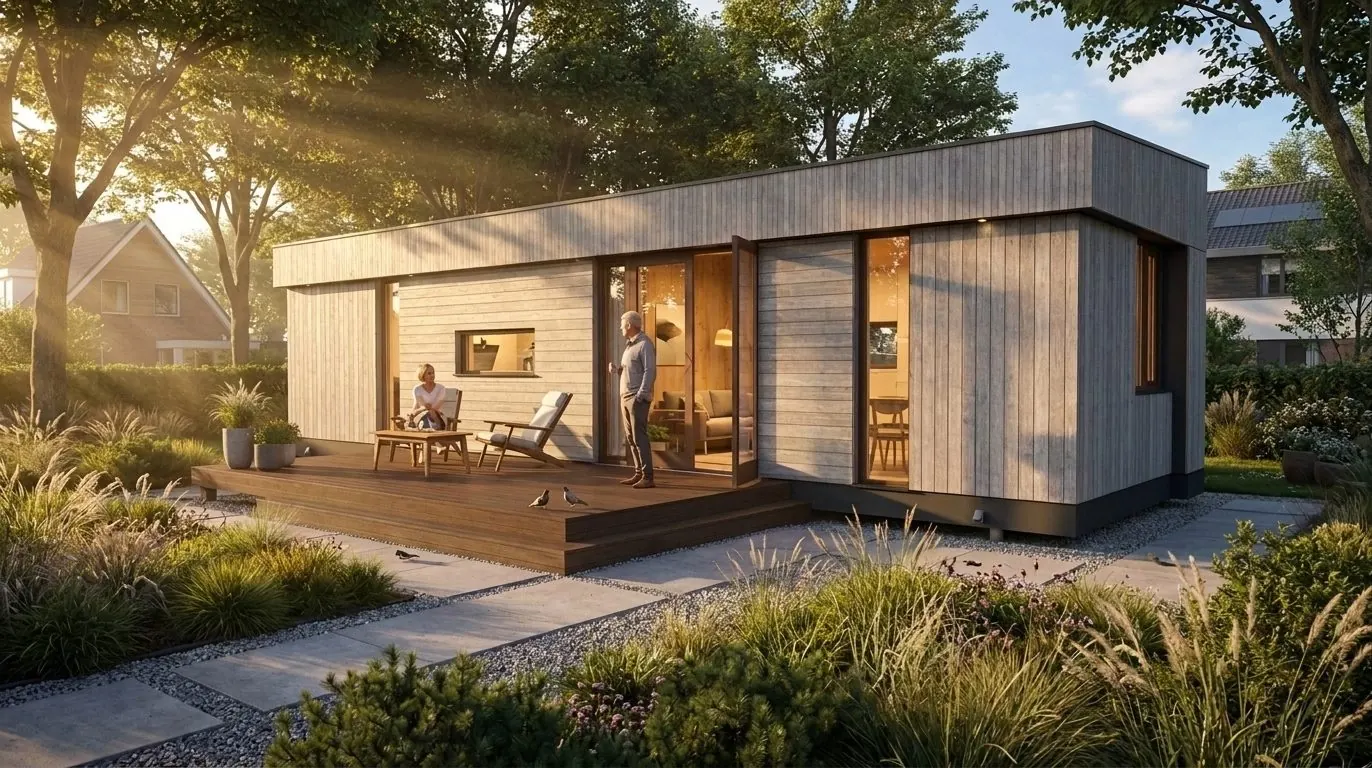
Can a home be placed on my plot?
In many cases a second home on a plot is possible, but it is not a standard yes. It depends on the zoning of your plot, the zoning plan of your municipality and the spot on your plot. So start by messaging us your plot details: we tell you whether it looks promising.
Do I need a permit?
Permanent residence in an extra home on your plot usually requires a permit in the Netherlands today. You apply for the permit yourself at your municipality. We do not submit an application and we have no contact with the municipality, but we share the architectural documents you need free of charge.
Will it be permit-free?
Under the Dutch rules for a family home, a home for first-degree family (partner, parents, children) is expected to become permit-free under conditions from 1 January 2027. All ancillary buildings on the plot together may not exceed 100 m². That is an expectation and not guaranteed.
Does the home meet the Dutch Building Decree?
Yes, in the Comfort and Prestige Pack. Those are designed as homes to live in and meet the Dutch Building Decree for new-build homes. The Essential Pack is a shell: because you finish it yourself (without bathroom and toilet), it does not yet meet the Dutch Building Decree.
Is my plot accessible for transport?
The home arrives on a low-loader and is placed with a crane. That requires an accessible spot for the crane truck and low-loader. Before you receive a quote, we check with our crane company whether placement on your plot is possible. That is free of charge.
Do I need a foundation, and who arranges it?
Yes, every home needs a stable foundation. You have it laid yourself. We do not advise on the foundation, but we introduce you to a foundation company.
How do I arrange the utilities?
You lay the utility lines up to 1 metre from the facade. We connect the home to them, including the outdoor unit of the heat pump. The costs differ per plot and distance to existing connection points.
What is the QuickScan?
The QuickScan costs €99 and gives you a clear yes or no for your situation. We deduct that amount from your quote. We donate the proceeds of the QuickScans to Stichting Zwerfjongeren Nederland. It is not advice on the foundation and not a guarantee for the permit.
What does it really cost?
What does a home on my plot cost?
The Aventura series starts at €89,500 (Medium, 38 m²), €109,000 (Large, 46 m²) and €179,000 (XLarge, 77 m²) for the Essential Pack, including VAT and excluding transport, placement and foundation. The Comfort Pack and the Prestige Pack are finished further and cost more. The price is in your tailored quote, so you get a clear cost breakdown in advance.
What is the difference between the Essential Pack, Comfort Pack and Prestige Pack?
Essential is the shell: wind and watertight, for those who finish it themselves. Comfort is technically complete with bathroom, boiler and heat pump (solar panels are always included; if you do not want them, that item can be taken off your quote), and you choose the kitchen and floor. Prestige is fully finished, including kitchen, floor and automatic screens: all that is left is moving in.
Which extra costs come on top?
Besides the home you should count on the foundation, the utility connections, transport and placement, and a permit if one is needed. Those costs depend on the location and differ per plot.
What does it cost to prepare my plot?
For an Aventura Large, count on roughly €8,000 to €22,000 including VAT for everything around your plot. That covers the groundwork with the foundation, a sewer, water and electricity line from your main house, transport with crane work, and connecting to the existing utility lines. Where you end up depends on four things: the distance from our factory to your plot, the size and weight of the crane needed, the connection costs we estimate for your situation, and how your plot is finished. An expensive finish sits at the top, a plot on sand with no finish at the bottom. Not included: an electrician, upgrading your fuse box, a permit if needed, and a structural engineer or foundation specialist. We do not advise on the foundation. Have it checked by a structural engineer or foundation specialist. This is an indication, not a quote.
What are the monthly costs?
Energy costs are low thanks to passive-house design principles: up to 75% lower than a similar, traditionally built new home. A vapour-open, biobased build-up and durable materials keep maintenance limited and predictable.
How does payment work?
You pay according to construction progress. After you and we have signed, you have a cooling-off period of 3 working days. You then pay 5% as security; if you prefer, you can deposit this amount with a civil-law notary instead (the notary’s fees are then yours). You then pay 30% when production starts, 30% when the home is wind- and watertight, 30% when it is ready for transport and 5% at handover. When production starts, at wind- and watertight and at ready for transport, you become the owner of what has been purchased or made for you by then. If the 5% is held by a notary, it remains there for three months after handover as a retention. The exact terms are in your agreement and our general terms (Dutch).
What if prices rise?
The price is fixed from the start of production, because that is when we buy the materials. If costs demonstrably rise before then, but more than three months after signing, we may pass on that increase. If it is 10% or more, you may withdraw at no cost. The exact terms are in our general terms (Dutch).
Is it a lasting solution?
How long does the home last?
A chalet or tiny house lasts 15 to 25 years. An Aventura is built to the quality of traditional timber-frame construction. Count on 100 years and longer, with timely maintenance carried out with care. Thanks to the vapour-open build-up, moisture cannot be trapped in the structure.
Do I need sun shading?
We advise yes. By passive-house principles, keeping heat outside in summer saves a lot of cooling load. External shading such as automatic screens stops the sun before it reaches the glass. You can take the screens straight away or add them later. They are included with Prestige. With Essential and Comfort they are an option, and you can have the cable routing prepared in advance. On very hot days an air conditioner can still be pleasant. Good shading and some shade on your plot partly determine how often you need it.
What is biobased building?
The load-bearing structure and the insulation consist of renewable materials, such as timber and biobased insulation. They can temporarily absorb moisture and release it again. Combined with a vapour-open build-up, that prevents hidden damage.
What are passive-house design principles?
A very well insulated shell, high airtightness and ventilation with heat recovery. As a result the heat stays inside in winter and outside in summer, without heavy heating or cooling systems.
What about maintenance?
Our homes are designed with maintenance in mind. You receive a maintenance plan. No structural renovation after ten or fifteen years is needed, just normal, predictable maintenance moments like any home.
What is the difference with a care unit or chalet?
Care units and chalets are built for temporary or recreational use, with lighter structures and limited insulation. In the Comfort and Prestige Pack an Aventura meets the Dutch Building Decree for new-build homes.
Which warranty do I get?
You receive a warranty certificate on handover. Examples: structure, roofing, timber window frames and facade cladding 10 years, insulating glass 6 years, water pipes and drainage 3 years, solar panels (Comfort and Prestige) 20 years on output. The warranties depend on correct use and maintenance. With Essential the warranty is limited to the shell components supplied.
How does the 2027 waiting list work?
In 2027 we build twenty homes. You sign up free of charge and without obligation, and the order of signing up determines when it is your turn. We call you to go through your situation.
Your question not here?
Just message us. You get an answer from us, not from a call centre.